
An AI chatbot is a software application that uses artificial intelligence to simulate human-like conversation — understanding what users type or say, and responding with relevant, contextual answers. Unlike simple rule-based bots that follow rigid decision trees, modern AI chatbots understand intent, handle follow-up questions, and get smarter over time.
How AI Chatbots Actually Work
Under the hood, most AI chatbots today are powered by Large Language Models (LLMs) — systems like GPT-4, Claude, or Gemini trained on vast amounts of text to predict the most useful response to any given input. When a user sends a message, the chatbot:
- Parses the input — tokenises and embeds the text into a vector representation
- Retrieves context — using RAG (Retrieval-Augmented Generation) to search your knowledge base for relevant information
- Generates a response — the LLM combines its training knowledge with retrieved facts to produce a grounded, accurate answer
- Maintains session context — conversation history is passed with each turn so the bot remembers what was said earlier
Rule-Based Chatbots vs AI Chatbots
Not all chatbots are equal. Understanding the difference is the first step to choosing the right tool.
| Feature | Rule-Based Bot | AI-Powered Bot |
|---|---|---|
| Understands natural language | ❌ No | ✅ Yes |
| Handles unexpected questions | ❌ Falls back to "I don't understand" | ✅ Infers intent and responds |
| Learns from your content | ❌ Manually programmed only | ✅ Trained on your docs, FAQs, website |
| Multi-turn conversation | ❌ Limited | ✅ Full context awareness |
| Setup complexity | Low (flow builder) | Low (upload content, done) |
| Maintenance | High (update every flow) | Low (update your knowledge base) |
The Technology Stack: NLP, LLMs, and RAG
Natural Language Processing (NLP) is the field of AI concerned with understanding human language. Early chatbots used NLP classifiers to detect intent — "Is this a refund question or a shipping question?" — and route accordingly. Modern LLM-based bots skip this step: they understand intent inherently from their training.
RAG (Retrieval-Augmented Generation) is the technique that makes business chatbots actually useful. Instead of relying solely on the LLM's training data (which has a cutoff date and no knowledge of your business), RAG pulls relevant passages from your specific documents, website content, and FAQs at query time. The result: answers grounded in your data, not hallucinated generalities.
At AIChatVault, every chatbot you create uses RAG by default. Upload your PDFs, paste your website URL, or add your support articles — the system indexes them into a vector database and retrieves the most relevant chunks for every user question.
What Can an AI Chatbot Do for Your Business?
- Answer customer questions 24/7 without a support agent on standby
- Qualify leads by asking the right questions and capturing contact details
- Guide users through product discovery and recommend the right options
- Handle order status, returns, and FAQs automatically
- Escalate to a human when the conversation needs a personal touch
- Collect structured data — name, email, budget, timeline — and push it to your CRM
Types of AI Chatbots
AI chatbots are deployed in many different contexts, each with distinct requirements:
- Customer support bots — handle tier-1 support, reducing ticket volume by 40–70%
- Lead generation bots — engage visitors, qualify interest, and book demos
- E-commerce assistants — answer product questions, track orders, recommend items
- Internal knowledge bots — help employees find policy documents, HR answers, or IT troubleshooting guides
- Appointment booking bots — collect availability preferences and schedule meetings

How to Choose an AI Chatbot Platform
When evaluating platforms, look for:
- Knowledge base flexibility — can you upload PDFs, crawl your website, paste text?
- Model choice — access to GPT-4, Claude, Gemini, and open-source models
- Integration depth — connects to your CRM, helpdesk, and e-commerce platform
- Human handoff — seamless escalation with full conversation context
- Analytics — understand what users ask, where bots fail, and track leads
- Widget customisation — matches your brand colours, language, and tone
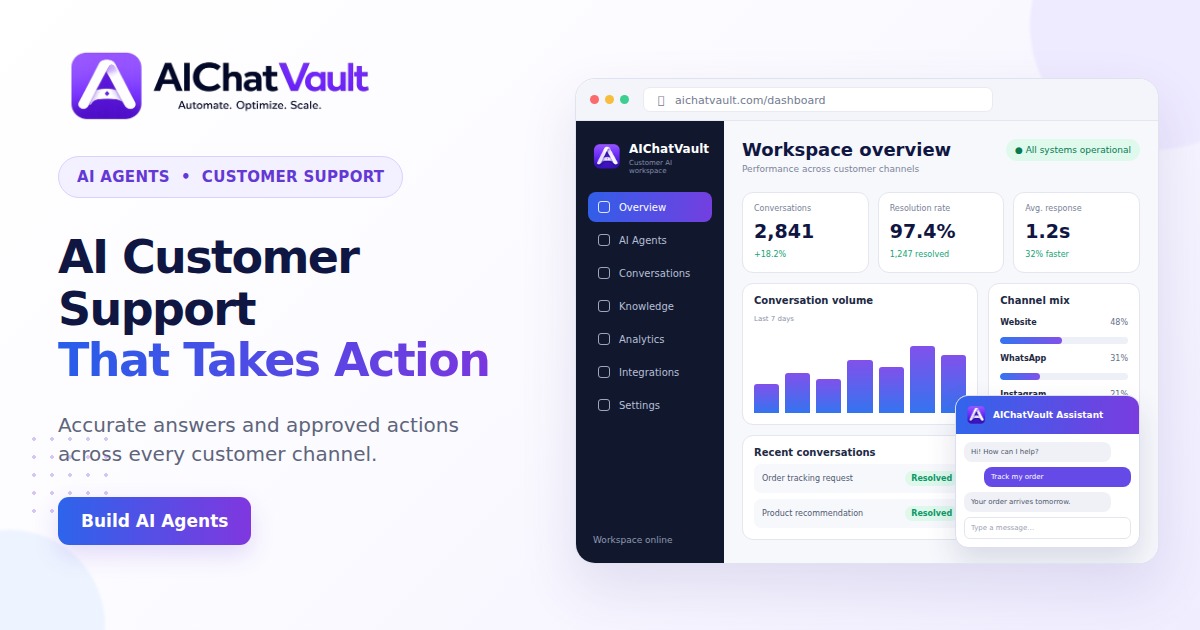
AIChatVault covers all of these out of the box. You can go from zero to a live, trained chatbot on your website in under 10 minutes — no developer required.
The Bottom Line
AI chatbots have moved from novelty to necessity. Businesses that deploy them effectively reduce support costs, generate more qualified leads, and deliver the always-on experience modern customers expect. The technology is now accessible to businesses of every size — and platforms like AIChatVault make it genuinely simple to get started.